The short answer: film the problem the moment you find it, report it in writing through the platform within 72 hours, write calmly and quote the platform's own rules back to it, and keep a card chargeback as your backup. Your own photos and video decide most of these cases.
The better answer is not to end up there. Before you book, look the place up on Booking.com and run DoNotStay, a free Chrome extension that reads every detailed guest review and flags cockroaches, bed bugs, mold and other problems that the score hides.
I've lived out of hotels and Airbnbs as a digital nomad since 2018. This year I asked for my money back twice. I won once and lost once, and the reason was the same both times.
Two refunds, two outcomes
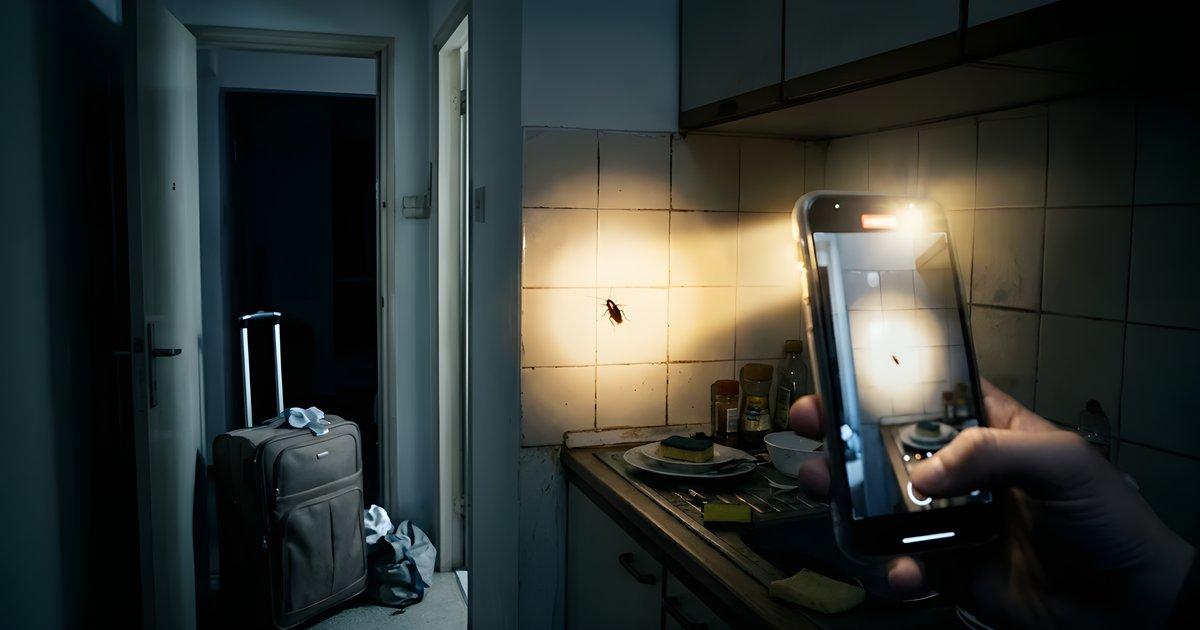
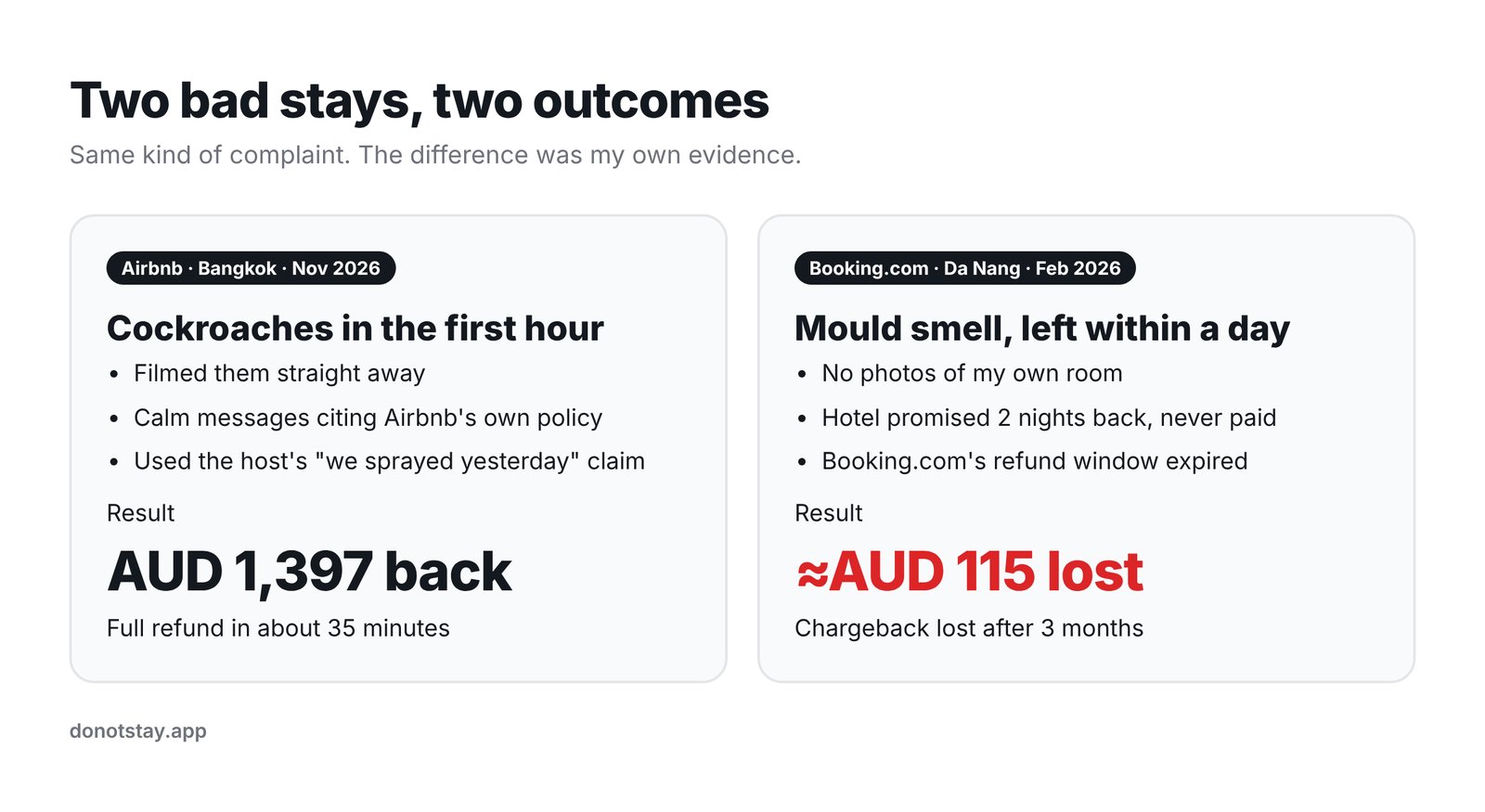
Bangkok, November 2026: full refund, AUD 1,396.83. I booked a well-rated Airbnb in Chatuchak for a month. Within the first hour I saw cockroaches. I filmed them, left, and contacted Airbnb support that night.
Support's first answer was not on my side. The host said the cleaner had been in the day before, found no cockroaches and sprayed pesticide. Support asked whether I'd stay while the host recleaned, and offered to try to get one night refunded.
The turning point was a reply I wrote with Claude's help that used the host's own claim. If the place was sprayed the day before and the cockroaches were still there an hour after I walked in, the spraying hadn't worked. That's not a one-off bug, it's an infestation that needs more than one treatment, and not somewhere to live for a month. About 35 minutes after that first answer, they cancelled the booking, refunded every cent to my card and flagged the listing.
A hotel in Da Nang, February 2026: lost about AUD 115. I booked three nights through Booking.com. The room smelled so strongly of mould that I had a headache and a sore throat within hours. I left within a day. The hotel agreed in writing to refund the other two nights, and Booking.com's support confirmed the hotel had offered it.
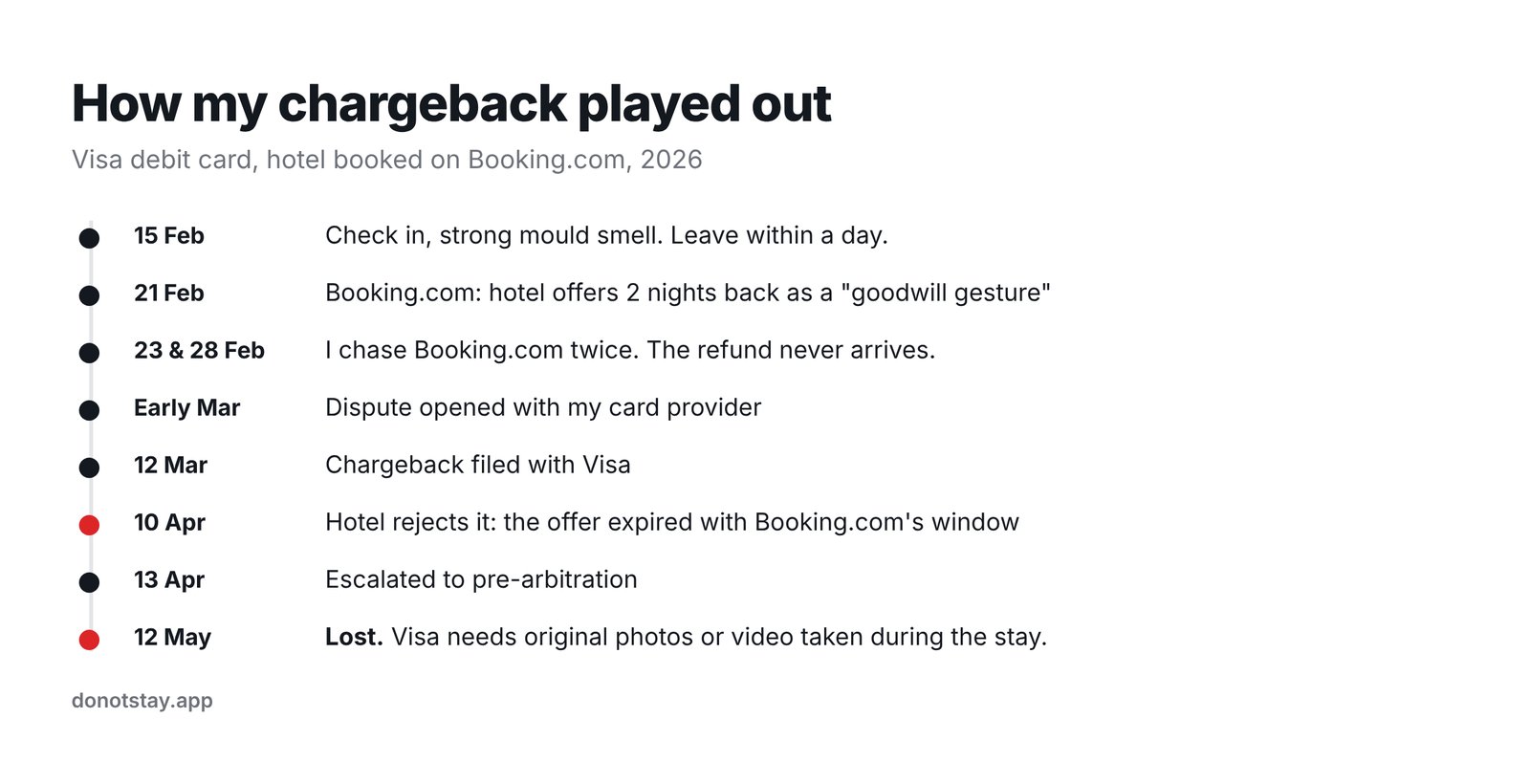
The refund never arrived. I chased Booking.com twice, the hotel's refund window on Booking.com expired, and the hotel then said it owed me nothing. I disputed the charge with my bank. It took three months and went to pre-arbitration with Visa, and I lost. The hotel argued that I had no photos of my own room, which was true. I had only other guests' photos from Google reviews, and Visa doesn't accept those.
Same kind of problem, same kind of complaint. One had my own video. One didn't.
Step 1: Film it before you do anything else
This is the step that decides the case, and it's the one people skip because they just want to get out.
- Take a video, not just photos. Start with a wide shot that shows the room, then move in on the problem. Say out loud what you're seeing, the date, and the room number.
- Keep the originals. Your phone stores the date and time in the file. Don't crop, filter or screenshot them.
- Film what you can of problems you can't see. A smell won't show on camera, but damp patches, black spots on grout, a dripping AC unit or a musty wardrobe will. Then describe the smell in writing straight away.
- Do it before you pack. Once you've left, the evidence is gone.
In the Da Nang case, my bank explained that Visa requires original photos or videos taken during the stay. Nothing else I sent made up for not having them.
Step 2: Report it in writing, inside the platform, the same day
On Airbnb, you have 72 hours from discovering the problem to report it to the host or Airbnb under its Rebooking and Refund Policy. The policy covers things like pests, health and safety hazards, and a place that's significantly different from the listing. How much you get back depends on how serious the problem is, how much of the stay it affects, and whether you leave. Message the host first, then open a case with Airbnb support if the host can't fix it.
On Booking.com, there's no equivalent guarantee. Your contract is with the hotel, and Booking.com mostly passes messages between you. So:
- Report the problem through Booking.com's messages or support, not just to the front desk or on WhatsApp, so there's a dated record that the platform can see.
- If the hotel agrees to a refund, ask for it to be processed through Booking.com right away, and set a date. A promise is not a refund. My hotel's written promise was worthless once the window closed.
- Keep chasing until the money is back on your card.
Booking.com moved most of its customer service to an outsourcing company, Majorel, in 2022. I worked at Booking.com in Amsterdam in 2017, and as a customer its support has felt noticeably worse since then. Don't expect it to fight for you. You'll need to push.
Step 3: Write like a calm person who has read the rules
My instinct when a booking goes wrong is to threaten: refund me or I'll do a chargeback. For the Bangkok case I used Claude to help me write my messages, and it talked me out of that. A threat turns the support agent into your opponent and makes it look like you're out to win at all costs. A calm message that asks them to apply their own policy gives them an easy reason to say yes.
What worked:
- Short and factual. What happened, when, and what you did about it.
- Quote the policy. For Airbnb, name the Rebooking and Refund Policy and the problem it covers (pests, cleanliness, safety).
- Attach the evidence. Video first.
- Use their own words. If the host or hotel claims something, ask what follows from it. The host's "we sprayed yesterday" was the strongest evidence I had that the problem was serious.
- Ask for one specific thing. "A full refund, as I left within the first hour" is easier to approve than "compensation".
- Stay polite when the first answer is no. First answers are often a script. Reply once more with the facts.
You can use Claude or another AI assistant to draft these messages. Paste in the policy, the timeline and what you want, and ask for a calm, firm message that isn't legalese. It saves you from writing angry, and it's good at spotting which part of a policy applies to you.
A message along these lines:
Hi, I checked in to [listing] tonight and found cockroaches in [where] within the first hour (video attached). Under Airbnb's Rebooking and Refund Policy, pests that make a place unsafe or unsanitary are a reservation issue. I've left the property and am staying elsewhere tonight. Please cancel the reservation and refund the full amount to my original payment method. Thank you for your help.
Step 4: A chargeback is your backup
If the platform and the property both refuse, ask your bank or card provider for a chargeback. This is a dispute run under the card scheme's rules (Visa, Mastercard, Amex). Your bank takes the money back from the merchant if your claim holds up.
What to know before you start:
- There's a deadline. In Australia you generally have up to 120 days, depending on the card scheme and the reason. Don't wait.
- You have to show you tried first. Banks ask for proof you tried to sort it out with the merchant. Your platform messages are that proof.
- Evidence matters most. The merchant gets to respond, and the scheme decides on the evidence. My dispute went through the first round and pre-arbitration, and lost on photos.
- It's slow. Mine took from early March to mid-May. Expect months, not days.
Should you book with a credit card or a debit card?
Use a credit card if you have one. How much it protects you depends on where you live:
- United States: the Fair Credit Billing Act gives you legal rights to dispute charges on credit cards, but it doesn't cover debit cards. Credit is clearly better.
- United Kingdom: Section 75 of the Consumer Credit Act makes your credit card provider jointly liable for purchases between £100 and £30,000. Booking through a middleman like a booking site can complicate this, but you lose it entirely on a debit card.
- Australia: chargebacks are available on both Visa and Mastercard credit and debit cards under the card schemes' rules. Some state consumer agencies say chargebacks aren't available on eftpos payments, so if your debit card asks, choose credit. My Da Nang dispute was on a Visa debit card and went the full distance, so a debit card isn't useless.
Even where the rules are similar, a credit card means it's the bank's money in dispute for those months, not yours.
Avoid the fight in the first place
The Da Nang hotel had warning signs before I booked: other guests had already posted photos of mould. Pests usually show up in a few reviews among hundreds of happy ones, which is why a 9.0 score won't warn you.
DoNotStay reads every detailed review on a hotel's Booking.com page and flags cockroaches, bed bugs, mold, noise and scams, with the dates and the guests' own words. It takes 30 seconds, and it's a lot easier than a three-month chargeback.
If you're choosing between booking sites, read Booking.com vs Expedia. For what to check in the room itself, read how to check for bed bugs in a hotel.