I've been booking hotels as a digital nomad since 2018 — sometimes for a few nights, sometimes for a month. After hundreds of bookings across Asia, Europe, and the Middle East, I've developed a few tricks that consistently save me money. But I wanted to know whether my instincts are backed by data.
Turns out, they mostly are. Here's what the research says — and what I've learned the hard way.
The 15-day sweet spot
The most-cited research on hotel booking timing comes from NerdWallet, which analyzed over 2,500 hotel room rates worldwide between 2019 and 2021. Their finding: booking 15 days before check-in was cheaper than booking 4 months out 66% of the time, with average savings of about $30 per night (13%).
The savings aren't uniform across hotel tiers. Luxury properties showed the most dramatic drops closer to check-in — averaging 22% cheaper at 15 days out. Mid-range hotels saved about 9%. Budget hotels barely moved at 5.5%, meaning if you're booking hostels or no-frills rooms, timing matters less.
More recent KAYAK data covering 2024–2025 pushes the sweet spot even closer. Their analysis found that booking within one week saved up to 26% on domestic hotels and 27% on international hotels compared to a month prior. The cheapest point was 7 days before check-in.
The distinction matters by hotel type. City hotels in competitive urban markets see the best prices in the final 48 hours as hotels slash rates to fill inventory. Leisure destinations like beach resorts are safer booked 1–2 months ahead. All-inclusive resorts reward booking 3+ months in advance since their fixed-cost structure means less incentive to discount last-minute.
Last-minute deals are real — hotels hate empty rooms
The logic is simple. An unsold room tonight generates zero revenue forever. Hotels operate on perishable inventory. Most properties allow free cancellation 24–48 hours before check-in, which means a wave of cancellations hits in the final days, leaving empty rooms that hotels would rather sell cheaply than waste.
HotelTonight reports same-day rates averaging 10% less than even the day before, with average discounts of 16% off published rates and occasional savings reaching 50%.
The risk is real though. During major events, the dynamic reverses. A 2024 analysis of 500 hotels found Dubai hotels carried 85% price premiums during events, and Las Vegas prices jumped over 50% in the final week before conventions. Event pricing data shows even more extreme spikes — Düsseldorf hotels during trade fairs surged 347% above normal rates.
If there's a major event in your destination city, book early. For everything else, waiting pays.
Check in on Sunday, not Friday
The day you make the reservation barely matters — KAYAK's data shows no meaningful savings tied to any particular booking day. The day you check in, however, matters a lot.
Sunday check-ins average $166 per night domestically, versus $205 for Friday arrivals — a gap of up to 24%. Hopper corroborates this, finding Friday check-ins cost 20% more than weekday arrivals.
The nuance is hotel type. In leisure destinations, weekends command premium pricing. But in business-heavy cities, the pattern flips — Houston's weekday rates run 23% higher than weekends due to corporate travel, and Washington DC carries a 20% weekday premium. Know whether your destination skews business or leisure, and time your stay accordingly.
January and November are the cheapest months
Seasonal pricing offers the largest absolute savings of any timing factor. KAYAK's 2024–2025 analysis shows US hotel prices bottoming in November at $167 per night and January at $168, versus a peak of $201 in June — a 20% seasonal swing. International hotels show an even larger spread, with November rates running 31% below June peaks.
A 2024 Vio.com study across 50 US cities found January rates averaging $160 per night — 20% below the annual average. Specific destinations show far more dramatic gaps: Virginia Beach drops roughly 50% in January, Florence offers 52% off in winter, and Aruba discounts by 68% in spring versus peak.
The Hotels.com 2025 Hotel Price Index found US hotel rates fell slightly to $174 per night average — down 2% year-over-year. But averages mask city-level variation. San Francisco dropped 9%, Austin fell 7%, while Asian destinations like Kyoto (+13%) and Tokyo (+12%) climbed sharply.
Book on the mobile app — this is the easiest money you'll save
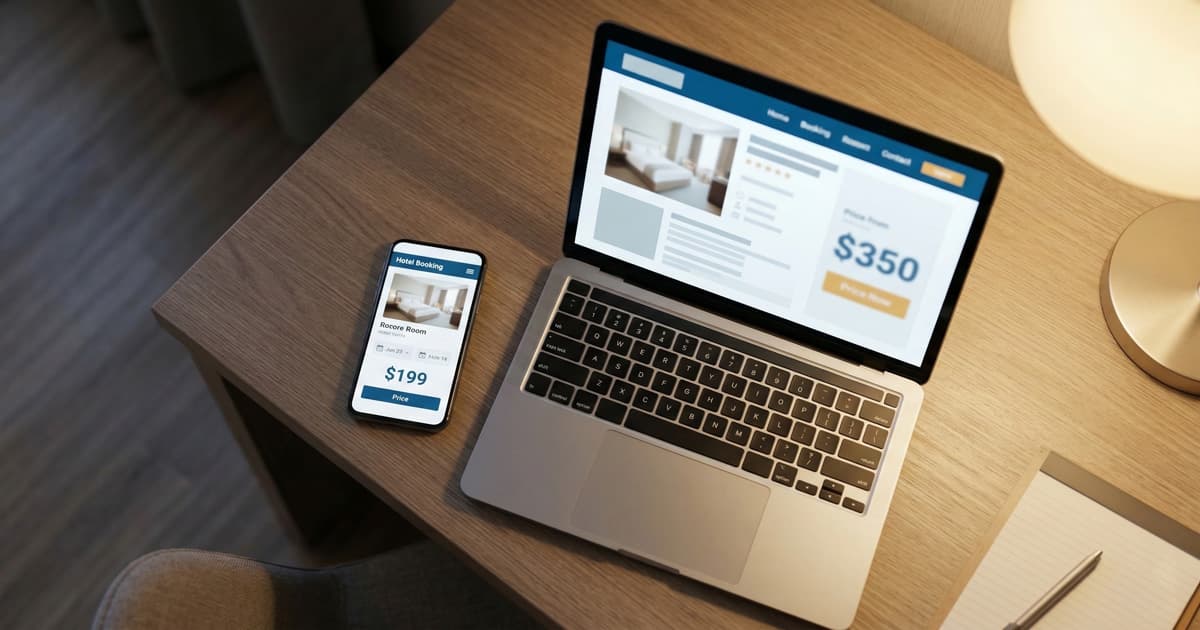
This is the trick most people miss entirely, and I can personally confirm it works. I regularly see 20–40% lower prices on the Booking.com mobile app compared to the desktop site for the exact same room.
The data backs this up. A 2024 investigation examined 35 hotels on Booking.com and found desktop prices were on average 16% higher per night. In 30 of 35 cases, mobile was cheaper, with the gap ranging from 4% to a staggering 52%.
This isn't a bug. Booking.com's partner documentation confirms that hotels can set "Mobile Rates" with a minimum 10% discount for app users. The economics are simple: acquiring a customer through the app costs Booking.com far less than bidding on Google Ads for desktop traffic.
A Which? investigation added important caveats. On Booking.com, 30% of listings had genuinely cheaper mobile prices. But Hotels.com's "mobile exclusive" claims were often misleading, and one Expedia "mobile deal" was actually more expensive on the app. The reliable play is the Booking.com app specifically.
Incognito mode doesn't help. A VPN might.
The belief that hotels raise prices when you search repeatedly is not supported by evidence. A Northeastern University study tested six major OTAs and found no systematic cookie-based price inflation. Consumer Reports tested 372 searches and found 88% showed identical prices in incognito versus normal browsing.
What is real, however, is geographic price discrimination based on your IP address. A 2025 PCWorld experiment found the same New York hotel cost $206 from a Phoenix IP, $269 from New Jersey, and $352 from San Francisco — a 71% markup based purely on location. NordVPN's testing showed US travelers could save $170 on a week-long London hotel stay by booking through a UK-based VPN server.
Skip incognito mode. If you're booking international hotels, a VPN connecting to the destination country's server is worth trying.
The "book now, rebook later" strategy
Free cancellation policies have created an entire rebooking economy. Booking.com's cancellation rate runs between 37% and 50% — the highest of any booking channel.
The strategy: book a refundable rate immediately to lock in availability, then periodically check for price drops and rebook at the lower rate before canceling the original. Always book the new rate first, then cancel the old one, to avoid losing your room if availability has tightened.
Services like Pruvo automate this entirely — monitoring your existing reservations and alerting you to price drops.
For a deeper look at how cancellation policies work on Booking.com — including the refund traps and timing tricks — see our Booking.com cancellation policy guide.
My personal trick for longer stays
Here's something I haven't seen in any guide. When I'm planning a month-long stay — which I do regularly as a nomad — I never book the full month upfront. Instead, I book 3 nights at the hotel I want to try, and simultaneously book a free cancellation reservation at the same hotel for the remaining month.
This gives me a 3-day trial. If the hotel is great, I keep the month-long booking. If it's terrible — mold, noise, bad location, whatever — I cancel the free cancellation booking at no cost and move on. I've only lost 3 nights instead of 30.
It limits my options slightly since I need a hotel that offers both short bookings and free cancellation on longer ones. But I've never regretted doing it this way. The few times I've bailed after 3 nights, I saved myself from a month of misery.
Check the hotel's own website last
Hotels pay OTAs between 15% and 30% commission per booking. That enormous margin creates strong incentive for hotels to match or beat OTA prices directly. SiteMinder's 2024 data found hotel websites generated 60% higher revenue per booking than OTAs.
The power move is the Best Rate Guarantee. If you find a lower OTA price, Marriott and Hilton will match it and add a 25% discount on top. Hyatt offers a match plus 20% off. One travel writer used Hilton's guarantee to drop a Santa Monica hotel from $686 to $465 per night — a single phone call.
Since the EU's Digital Markets Act forced Booking.com to drop rate parity clauses across Europe, hotels there can now legally undercut OTA prices on their own websites. Always check the hotel's direct site after finding a property on Booking.com or Expedia.
If you're still deciding between booking platforms, our Booking.com vs Expedia comparison breaks down the key differences.
The savings don't matter if the hotel is terrible
You can time your booking perfectly, use the app, stack Genius discounts, and save 40% — and still end up in a hotel with cockroaches in the breakfast lounge and mold behind the bathroom mirror.
Timing saves you money. Checking the reviews saves your trip.
I built DoNotStay because I got tired of learning about hotel problems after I'd already checked in. It's a free Chrome extension that analyzes every detailed review on a Booking.com hotel page and flags the specific issues ratings hide — pests, hygiene, noise, scams, hidden cameras — with evidence from actual guest reports.
Find the best price, then check whether the hotel deserves your money. Add DoNotStay to Chrome — free →