Vrbo is one of the oldest vacation rental sites on the internet. If you're asking whether it's legit, you've probably heard a story about someone who paid for a beach house that didn't exist.
The short answer: yes, Vrbo is legit. The platform is real, owned by one of the biggest travel companies in the world, and your money is protected when you book and pay through it. The scams happen when you're pulled outside the platform — and the bigger everyday risk is a home that looks nothing like its photos.
DoNotStay, a free Chrome extension, reads a listing's guest reviews and flags mold, pests, safety problems and misleading listings before you book. It works on Airbnb and Booking.com, where many Vrbo homes are listed too.
Vrbo is legit — here's the background
Vrbo started in 1995 as Vacation Rentals by Owner, when a retired teacher put his Breckenridge ski condo online. HomeAway bought it in 2006, and Expedia Group bought HomeAway, including Vrbo, for $3.9 billion in a deal that closed in 2016. The brand became "Vrbo" in 2019.
Today it has more than 2 million properties in 190 countries. Unlike Airbnb, Vrbo only lists entire homes — no shared rooms.
When you book and pay through Vrbo's own checkout, the booking is covered by Vrbo's guarantee — long called the Book with Confidence Guarantee, now VrboCare. It covers host cancellations, check-in problems, payment fraud, and homes that are significantly different from the listing.
How Vrbo scams actually work
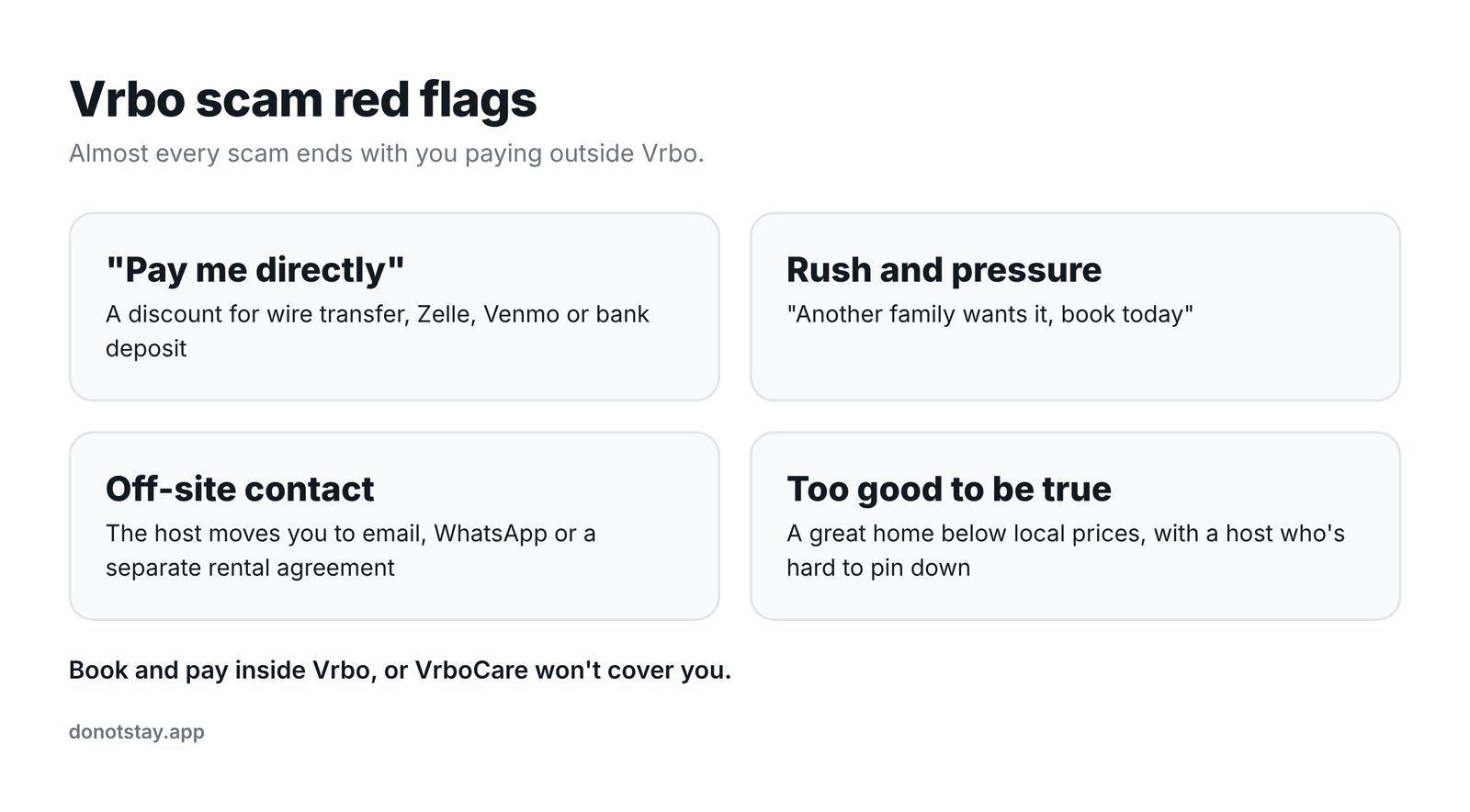
Almost every Vrbo scam has one thing in common: at some point, you stop paying through Vrbo.
Off-platform payment requests. The "host" offers a discount if you pay by wire transfer, Zelle, Venmo or a bank deposit instead. Once you do, Vrbo's guarantee no longer applies, and those payment methods offer almost no fraud protection.
Hijacked host accounts. Scammers take over a real host's email or account, then message guests and push them to book quickly — off the site.
Fake listings. Stolen photos of a real home, a price slightly too good, and a host who is hard to pin down. Consumer advocate Christopher Elliott documented a case where a family paid for a Paris rental by wire transfer under a separate "rental agreement" — and never stayed in it.
The pattern is always the same: pressure, a reason to pay outside the platform, and a payment method you can't reverse.
The everyday risk: a home that isn't what it looked like
Outright scams are rare. Disappointing homes are not. Mold, pests, broken air conditioning, a "quiet street" next to a bar — these show up in reviews long before they show up in the listing description.
Vrbo hosts write their own listings and choose their own photos. Nobody inspects the home before you arrive. The only independent signal you get is what previous guests wrote.
How to book on Vrbo safely
Never pay outside Vrbo. Not for a discount, not for a "deposit", not because the host says the site is having problems. If a host insists, report the listing and move on.
Pay with a credit card. It gives you a chargeback option if something goes badly wrong.
Check how far back the reviews go. A listing with reviews spread over at least six months is far less likely to be fake than one with three glowing reviews from last week.
Look for the same home on other sites. Many Vrbo homes are also listed on Airbnb or Booking.com. If you find it there, you get a second set of reviews.
Read the worst reviews first. One bad stay can be bad luck. Two guests mentioning mold or bugs is a pattern.
Then run DoNotStay on it. If the home is also on Airbnb or Booking.com, DoNotStay reads every detailed review there and flags mold, pests, safety problems and misleading listings, with quotes from the guests who reported them.
So, is Vrbo legit?
Yes. Vrbo is a legitimate platform owned by Expedia Group, and bookings paid through it are protected.
The scams happen outside the platform, so keep every payment on Vrbo. And remember that a real listing can still be a bad home — the guest reviews will tell you which.
Check any listing in 30 seconds. Add DoNotStay to Chrome — free →