Every hotel chain claims to be clean. After COVID, they all launched branded cleaning programs with hospital partnerships and electrostatic sprayers. Five years later, most of those programs have quietly disappeared — but the prices haven't come down.
As someone who's stayed in hundreds of hotels across Asia, Europe, and the Middle East since 2018, I can tell you that a hotel's star rating tells you almost nothing about whether the sheets were actually changed. Here's what the data says about which chains are cleanest, which are dirtiest, and how to check for yourself.
The cleanest hotel chains, according to independent data
Multiple independent surveys converge on the same winners.
The J.D. Power 2025 North America Hotel Guest Satisfaction Index — surveying 39,219 guests across 102 brands — names cleanliness the biggest driver of guest room satisfaction for 28 consecutive years. The 2025 segment winners: Ritz-Carlton leads luxury at 779/1000, Drury Hotels tops upscale at 738, and Tru by Hilton wins midscale for the third consecutive year at 723.
The ACSI 2025 Travel Study, based on 16,771 surveys, ranks Hilton first at 80/100, followed by IHG at 79, and Marriott at 78. At the brand level, Marriott Hotels scores highest at 82, with Hilton Hotels & Resorts and Holiday Inn Express tied at 81.
The UK's Which? consumer survey awards five stars for cleanliness to Hotel Indigo (IHG) and Sofitel (Accor). Consumer Reports placed Ritz-Carlton and Four Seasons at the top, with Embassy Suites leading the upscale national chains.
The pattern: Hilton's portfolio dominates the mid-tier (Hampton, Tru, Home2 Suites are all multi-year J.D. Power winners), while luxury brands from Marriott and Hyatt lead at the top end. Drury Hotels — a regional chain with just 150 properties — consistently outperforms far larger competitors, likely because its owner-operated model provides tighter quality control than franchise-heavy mega-chains.
Here's what a DoNotStay analysis looks like for a Ritz-Carlton property — the kind of result you'd expect from a chain that tops every cleanliness ranking:

The Ritz-Carlton Melbourne delivers on its promise of spectacular views and luxury amenities, with most guests praising the stunning location, comfortable rooms, and exceptional facilities. However, service quality can be inconsistent, with some staff appearing undertrained and communication issues affecting guest requests. While the hotel maintains high standards in most areas, breakfast offerings and hot water reliability have drawn criticism from multiple guests.
🚩 Red Flags
The dirtiest hotel chains have a data problem they can't hide
At the other end, the data is equally clear.
Baymont (Wyndham) scores just 62 on the ACSI — the lowest of any named brand, a full 20 points below Marriott Hotels. Motel 6 scores 67. Days Inn scores 70.
On ConsumerAffairs, the picture is grimmer. Econo Lodge holds a 1.6-star average with 77% one-star reviews — guests report finding syringes, cockroaches, mold, and cat urine smell. Days Inn averages 1.7 stars with 61% one-star reviews citing bed bugs, mold, and worse. Motel 6 averages 2.0 stars with 66% one-star reviews.
Wyndham's brand portfolio — Days Inn, Super 8, Baymont, La Quinta, and Ramada — appears on virtually every "dirtiest hotels" ranking compiled from consumer data. At the company level, Wyndham scores just 71 on the ACSI versus the industry average of 76.
Bed bugs don't care about star ratings
The Bed Bug Registry tracks crowd-sourced pest reports by chain. Holiday Inn leads with 732 locations reported, followed by Days Inn (560), Super 8 (550), Best Western (519), and Hampton Inn (505). Raw numbers correlate with property count — chains with more hotels naturally accumulate more reports.
But here's the uncomfortable truth: 89% of pest control professionals reported treating bed bugs in upscale hotels in the prior year. A 2024 Sleep Doctor survey found 14% of hotel guests reported a bed bug encounter. Bed bugs travel in luggage, not by star rating. I wrote a complete guide to checking for bed bugs if you want the full inspection protocol.
COVID cleaning programs are mostly gone
Every major chain announced enhanced cleaning in 2020. Hilton CleanStay partnered with Lysol and Mayo Clinic. Marriott's Commitment to Clean assembled a Global Cleanliness Council with Ecolab and Purdue University. Hyatt committed all 900+ properties to GBAC STAR accreditation. The marketing was everywhere.
Five years later, the visible measures have mostly vanished. Room seals gone. In-room wipes discontinued. Electrostatic sprayers shelved. Sanitizer stations reduced.
The single biggest lasting change is the elimination of automatic daily housekeeping — and it's a cost cut, not a safety measure. Hilton moved to opt-in housekeeping for all non-luxury brands in 2021. Marriott implemented a tiered system where only luxury brands like Ritz-Carlton get daily cleaning. J.D. Power's 2025 study found 44% of guests consider daily housekeeping a "need-to-have" — but most aren't getting it unless they specifically ask.
The industry's average daily rate hit a record $158.67 in 2024. Guests are paying more and getting less cleaning.
Undercover investigations show what really happens
Inside Edition's investigation sprayed invisible fluorescent paint on hotel sheets, checked out, then re-booked the same rooms. Three of nine hotels — a Candlewood Suites (IHG), a La Quinta, and a Residence Inn by Marriott — did not change sheets between guests. At La Quinta, the manager brought a maid who claimed she'd cleaned the sheets — until the UV light revealed the message still glowing on the fabric.
They repeated the investigation during COVID, when every chain was promoting enhanced cleaning. A Hyatt Place and a Hampton Inn both failed to change sheets.
A University of Houston study found 81% of hotel room surfaces tested positive for fecal bacteria. TravelMath's bacteria study found the average hotel bathroom counter harbored over 1.2 million colony-forming units per square inch — and 5-star hotel remotes tested at higher bacteria levels than 3-star ones. Higher price doesn't mean cleaner rooms.
Booking platform cleanliness scores are broken
Here's something most travelers don't realize. On Booking.com, the cleanliness sub-score is completely independent of the overall Guest Review Score. A guest can rate cleanliness 3/10 while giving an overall 8/10, and only the 8 counts toward the headline number. A hotel can maintain a respectable overall score while accumulating terrible cleanliness ratings that most travelers never notice.
TripAdvisor uses cleanliness as an optional sub-category that doesn't directly drive its Popularity Index. Google Hotels has no dedicated cleanliness sub-score at all. Expedia includes cleanliness among five sub-categories and uses a "Guest Experience" factor that can affect search rankings — arguably the most consequential system of the three.

This Marriott property has serious health and safety issues that make it unsuitable for guests. Multiple recent reports confirm cockroaches in rooms and restaurants, widespread mold problems with musty odors in rooms and pillows, and consistently poor cleanliness standards including dirty bathrooms, unwashed floors, and stained linens. While the location and some staff receive praise, these critical hygiene failures at a supposed 5-star resort create an unacceptable risk for any traveler.
🚩 Red Flags
TrustYou's analysis of 50,000+ hotels reveals the scale of the problem: 1 in 4 guest reviews mention cleanliness, and the share of positive cleanliness reviews in the US averages just 83%. Cleanliness mentions are increasing while sentiment is declining. These signals are buried in review text that most travelers never read.

This Marriott property in Seminyak has excellent staff and a prime location, but faces significant challenges with noise from pool parties, construction, and poor soundproofing affecting 16% of recent guests. Maintenance issues including mold, stained furniture, and cleanliness concerns are reported by 8% of visitors. The pool area becomes overcrowded with insufficient seating. While many guests love the breakfast and service, the noise and maintenance issues prevent a confident recommendation for those seeking a peaceful, well-maintained stay.
🚩 Red Flags
Here's what this looks like in practice. These are Marriott and Hilton properties — chains that top the industry cleanliness rankings — where review analysis tells a very different story from the headline score:

Multiple guests have reported bed bug encounters with photographic evidence, including whole families being bitten. The hotel's response has been inadequate, offering only room changes rather than proper remediation.
🚩 Red Flags
The housekeeping crisis behind the scenes
The cleanliness gap has a structural cause: the industry is chronically understaffed. AHLA surveys show that by late 2024, 65% of hotels still reported staffing shortages, with housekeeping the hardest position to fill. The hotel industry employs 196,000 fewer workers than in February 2019.
A standard housekeeper cleans 12–18 rooms per 8-hour shift, spending 20–30 minutes per room. Budget properties push 18–20 rooms per shift; some demand up to 30. When guests decline daily cleaning for multiple days, the resulting checkout clean takes far longer — but housekeepers are still expected to maintain the same pace.
In September 2024, approximately 10,000 hotel workers walked off the job at 25 hotels across 8 cities, demanding higher wages, fair workloads, and the restoration of automatic daily cleaning.
How to actually check your room on arrival
A two-minute inspection before unpacking catches the worst problems. Place luggage in the bathroom first — porcelain surfaces are too slick for bed bugs to climb.
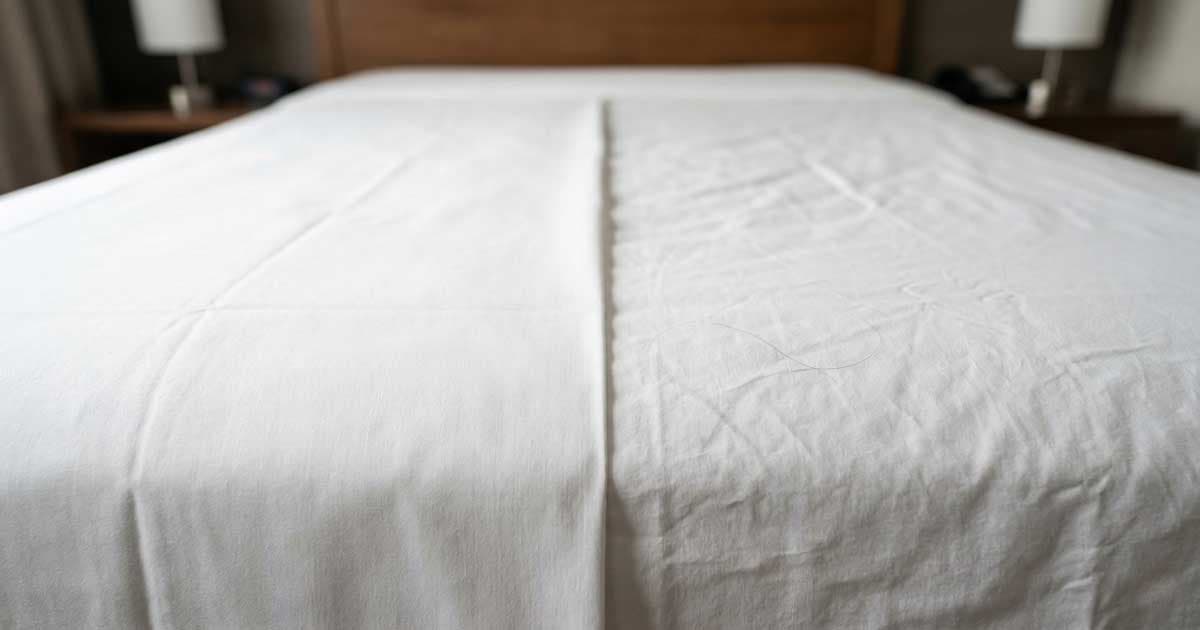
Check the bed. Pull back all sheets and inspect mattress seams for dark spots (bed bug fecal matter), reddish-brown stains, or tiny white eggs. Look for stray hairs or stains on sheets — their presence means linens weren't changed. Freshly laundered sheets show crisp fold lines; used ones look wrinkled or rumpled.
Check the bathroom. Look for mold in grout lines, around shower edges, and under the sink. Check for stray hairs in corners. Inspect the toilet seat and mirror for fingerprints.
Check high-touch surfaces. Run a finger across the nightstand and desk for dust. Visually inspect the TV remote, light switches, door handles, and thermostat — the University of Houston study found these among the most bacteria-laden surfaces.
Optional: bring a UV flashlight (~390nm, $15–30). It reveals biological residue invisible to the naked eye under complete darkness. Cleaning product residue also glows, so fluorescence isn't definitive — but large, obvious stains on sheets under UV light tell a clear story.
If you find problems, document with photos, request a different room (for bed bugs, request one far from the original — they travel through walls), and leave an honest review with specifics.
Star ratings measure amenities. Reviews measure cleanliness.
A 2025 study published in SAGE journals confirmed what most travelers already suspect: hotel star classifications primarily reflect facilities and services, and don't consistently predict guest satisfaction with cleanliness, comfort, or value.
The most reliable signal isn't a star rating or even a sub-score. It's the patterns in review text — 40 guests mentioning hair in the bathroom, 25 mentioning stained sheets, 15 mentioning musty smell. That pattern reveals a systemic housekeeping failure that no average score would surface.
That's exactly what DoNotStay is built to find. It's a free Chrome extension that analyzes every detailed review on a Booking.com hotel page and flags specific cleanliness issues — mold, dirty sheets, pests, stains — with evidence from actual guest reports. The patterns that ratings hide, DoNotStay surfaces in 30 seconds.
Find out about the dirty sheets before you book. Add DoNotStay to Chrome — free →